

If you’ve been banging your head against the wall, wondering why your traffic is flatlining or why your bounce rate is skyrocketing, I have some bad news: It might be you. Or specifically, it might be the way you are writing if you are unaware, stop writing blog posts like this immediately
The digital landscape has shifted. What worked in 2020—or even early 2024—doesn’t work anymore. Readers are tired. They are exhausted by clickbait that delivers no value, AI-generated fluff that sounds robotic, and “SEO-optimized” word salads that say nothing. If you want to survive as a content creator today, you need to change your approach.
Here is why you need to stop writing blog posts “like this” immediately, and exactly what you should do instead.
1. Stop Writing for Robots (They Don’t Buy Anything)
For years, the golden rule of blogging was “Keywords, Keywords, Keywords.” You would stuff the phrase “best running shoes for men” into a paragraph five times until the sentence barely made sense.
Stop it.
Google’s algorithms (especially with recent core updates) have evolved. They now prioritize “Helpful Content” and “User Intent.” If you write strictly for the algorithm, the algorithm might find you, but the human reader will hate you. When a human lands on your page and sees unnatural, repetitive phrasing, they leave immediately. This sends a signal to Google that your page is low quality, tanking your rankings anyway.
The Fix: Write for the human first. Use your keywords naturally. If you are writing about running shoes, talk about comfort, blisters, and marathon training—not just the search term.

2.The “Wall of Text” is Killing Your Engagement
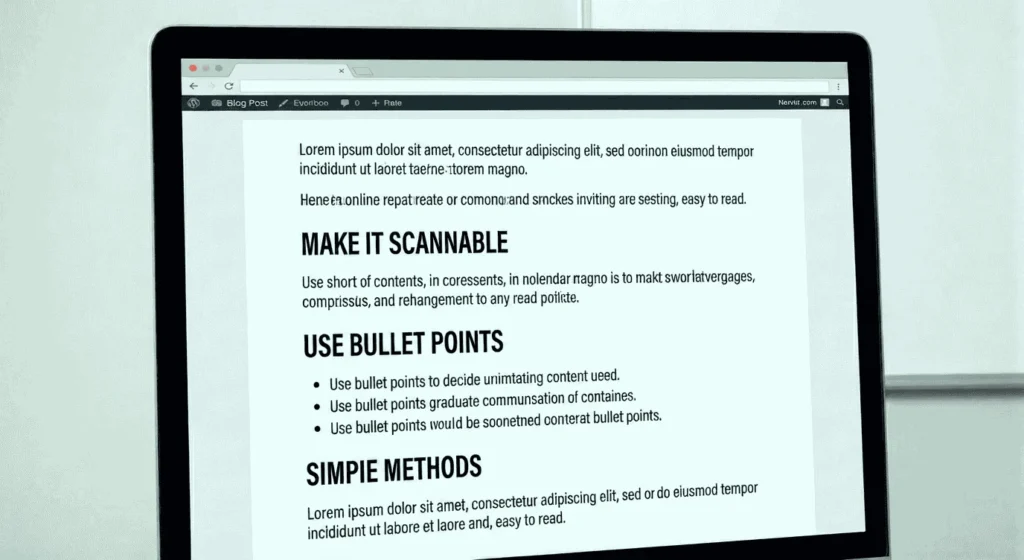
Look at your last blog post on a mobile device. If you see a solid block of text that takes up the entire screen without a break, you are committing a cardinal sin of blogging.
Modern readers do not read; they scan. We are living in the age of the 8-second attention span. When a reader sees a massive paragraph, their brain interprets it as “work.” They will click the back button before reading a single word.
The Fix: Break it down.
Keep paragraphs short: 2 to 3 sentences maximum.
Use Bullet Points: Like this list right here. It makes data digestible.
Use Subheadings (H2 and H3): Allow the reader to scroll down and find exactly what they need in seconds
Also read – Top 4 Affiliate Marketing Platforms for Maximum Traffic Sources

3.Stop Being a Wikipedia Entry
Unless you are actually Wikipedia, nobody is coming to your blog for a dry, factual recitation of history. If your post sounds like a high school term paper—formal, stiff, and devoid of emotion—you are failing to build a connection.
Many writers fall into the trap of “Professionalism.” They think that to be taken seriously, they must strip their writing of all personality. The result is generic content that could have been written by anyone (or any machine).
The Fix: Inject your voice. Use “I” and “You.” Tell a story about a mistake you made. Use a metaphor. If you are funny, crack a joke. If you are controversial, state your opinion. People follow people, not encyclopedias.
4.You Are Burying the Lead
In journalism, “burying the lead” means putting the most important information at the end of the story. In blogging, this happens when you write a 400-word introduction about the history of coffee when the user just searched for “How to use a French Press.”
If a user clicks on your title, they have a specific problem. If you spend five minutes clearing your throat and setting the scene, they will go to a competitor who answers their question in the first paragraph.
The Fix: Get to the point. Use the “Inverted Pyramid” style. Give the answer upfront, then use the rest of the article to explain the why and the how.

5.Ignoring the “So What?” Factor
You just wrote 1,000 words on a topic. Great. But did you answer the “So What?”
A lot of content creates information without application. It explains a concept but doesn’t tell the reader how to use it in their daily life. If a reader finishes your post and thinks, “Okay, but what do I do now?” you haven’t finished your job.
The Fix: Every post needs a Call to Action (CTA) or a practical takeaway. Don’t just explain a theory; give them a checklist, a step-by-step guide, or a challenge to try immediately.
The Bottom Line
The internet is flooded with mediocre content. To stand out, you don’t need to be the smartest writer in the room; you just need to be the most human.
Stop writing for algorithms. Stop writing walls of text. Stop being boring. Start writing content that respects your reader’s time and intelligence. If you make that shift today, you won’t just see better SEO rankings—you’ll build an audience that actually cares about what you have to say.